
Mirrors; the cycles I see myself in; reflect endlessly throughout the thread of humanity that unites me to the source of myself.
The line between me and the reflection was non-existent. It was all part of the same experience. It needed me to be reflected within it. Every person saw themselves in me too. We are no one without our reflections; they reveal our nature.
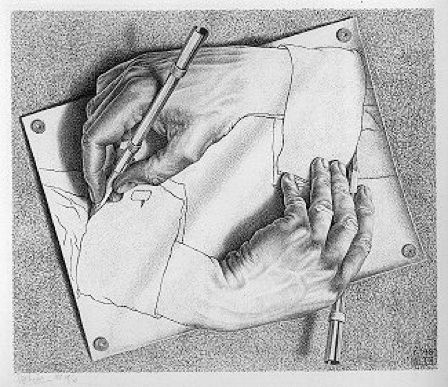
Reflecting what? Nothing but itself. We are nodally recursive, fractal-like, self-referential, conditioned biochemical pattern-makers. Just as we feed on the lower, the higher feed upon us. As above, so below.
Continuous suffering arises from the constant search for stability in a world of change. This leads to the persistent assumption that something permanent or stable must be found. That belief traps us in a loop that demands our constant attention. But when the mechanism of attention is overridden, the assumption collapses. In that collapse is the opportunity for complete acceptance of experience itself. The notion of an “I” is revealed for what it is: an artifact of experience.

All memory is the realization of recurring phenomena, a reference point for what is being investigated through our attention. Memory is always contextualized by the present. Nothing about memory is strictly former; it is a pattern of noticing recurrence, the oscillation of discrimination between observable phenomena and their prior conditions. A rehearsal of familiarity, symbolic or relational patterns repeating under similar conditions. This is, qualitatively, the foundation of many operations within embodied existence.
Habitual repetition and the continuous cohesion of prior understanding with current experience form the basis of the identification faculty. Its subconscious behavior gives rise to the narrative of a conscious self-concept. It reinforces the labeling of “things” in experience and their relation to the subjective witness. This abstract reality depends heavily on the structure of language and the way we communicate with others.
This creates a superficial division in the pursuit of self-realization. Language always implies separation; it describes something as other than the self. Using it to seek the self is like trying to see your reflection without a mirror. Thoughts are abstractions of experience; reflections. Feelings are direct impressions. And attention itself is the purest encounter with experience.
These words are merely conventions for understanding relationships between things. They can only point toward the non-conceptual nature of awareness yet; never fully describe it.
Our capacity for awareness constantly directs attention towards desirable, exciting or pleasurable phenomena it seeks out comfort, it’s other purpose is aversion to unpleasant, boring, painful or harmful phenomena, it seeks to avoid discomfort. This is hardwired into us and many other creatures in our CNS or central nervous system responses.
Fight, Flight, Freeze, Rest, Digest, Ingest, Investigate, Mate, Create
These are the primary response of the bodily/somatic function, they relate to nearly everything in our day to day life and are reactions or attentive responses towards our experiences.
Yet in our modern era we clearly find that even with easy access to all the things we need to survive; we still have a mental health crisis, we still have a world continuously seeking for meaning and purpose and never properly finding it, why are we feeling this “emptiness”. Reliving this cycle of dissatisfaction over and over?
Let’s say you really want a cookie, you eat one, it taste great, you have another it doesn’t taste as good as the first but still alright, you go for the third, it tastes ok but the novelty is definitely not there as much, and by the 4th cookie you’re already kinda sick of eating cookies.
This is the nature of craving: its hunger is not for the object, but for the first encounter with the object. A moment of freshness that cannot be repeated, only chased. So we escalate: more cookies, more pleasure, more novelty. Yet with every repetition, the encounter grows duller. And still, the desire sharpens. It is not satisfaction we crave: it is the illusion of fulfillment just out of reach. We are chasing a memory of intensity, an echo that recedes as we draw near. Expectation breeds both the fire of desire and the ash of disappointment.
In this cycle, attachment becomes a form of self-deception. We cling not because we are fulfilled, but because we are terrified of emptiness. Yet even more terrifying is what lies beyond the emptiness; unknowing. That which cannot be named, measured, captured, or shared.
So the mind doubles down on the known. It narrows attention toward only those experiences that reinforce what is familiar, desirable, controllable. This leaves us vulnerable to exploitation. In a world where attention is currency, every system is built to hijack our nervous responses; stimulate our dopamine, tap into our limbic loop, seduce us with speed, convenience, visibility. And so, craving becomes institutionalized. Addiction becomes architecture. We no longer suffer in private, we suffer by our own design and institutions from religion to the entertainment industry benefit from this state of disordered ignorance, from that suffering.
Addiction is not a flaw of character; it is a natural result of living in a society that offers constant stimuli while divorcing us from contemplative presence. The world promises relief, but only in the form of further engagement. Every desire fulfilled only increases the appetite for the next.
Here lies the core paradox: the more we seek to escape the present, the more painful the present becomes. The more we try to consume fulfillment, the more insatiable we feel. But what we are truly starving for is contact; a return to what is immediate, unfiltered, and unabstracted by expectation.
This is not the kind of presence advertised by self-help slogans or mindfulness apps. It is raw, often uncomfortable. It asks us to encounter ourselves not as ideas, or images, but as processes: flux, breath, tension, sensation. It demands we give up the pursuit of becoming someone, and instead become no one. Not in nihilism, but in clarity. In this stillness, we no longer measure our lives by outcomes, identities, or impressions, but by attentiveness itself.
The Western mind, conditioned to perform, compare, and consume, finds this unbearable. It confuses performance for worth, visibility for truth, aesthetics for essence. It fears self-realization because to truly see oneself is to dismantle the illusion of control. What we call “identity” is often a barrier, a costume stitched from expectation and fear. The fear that if we are not seen a certain way, we are nothing. The deeper fear is that this nothing might actually be our most real state.
But this nothing is not emptiness. It is openness. Spaciousness. The space in which a leaf falls, a breath rises, a child laughs, a hand trembles, the smell of damp concrete is noticed, the sensation of hair brushing our skin. When we are present to the content of awareness; not clinging, not pushing; we do not escape the world; we enter it. We see that all things are reflections. All things are sacred. Even the ordinary.
To drink water and taste it, to walk and feel the ground, to listen without needing to respond. These are acts of devotion. When the attention no longer seeks to manipulate or possess, experience reveals its depth. What was once mundane becomes mystic, The spiritual life is not hidden in temples or retreats: it unfolds in laundry, in streetlights, in shared silence, in grief.
Thus, the highest realization is not a vision of heaven, but the revelation that this, just as it is, has always been enough, and this experience effortlessly unravels and the vast majority of suffering behind it is merely attachment or expectation of an outcome.
Liberation of suffering is not done by becoming something else, but by being what you are authentically. Not beyond this world, but within it.
 A Helper of Hermes