
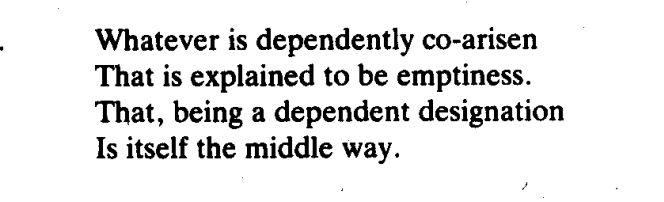
No nature is fixed other than the condition that everything that is taken to be a thing changes.
All attempts at reification of a self are static conceptions grasping at dynamic existence.
They are phantoms, assumptions of a consistent self-concept.
There are no origins or substantial existence beyond the conventionally posited, dependently arisen patterns that sustain phenomena.
Conventionally posited, dependently arisen patterns are not always prior to what they support. They may be simultaneous, reciprocal, recursive, or mutually defined.
All conventionally posited, dependently arisen patterns arise in dependence on other such patterns.
It is a potentially infinite mesh that privileges no point. The mesh itself is nothing apart from the relations it describes. It does not bear inherent self-nature, because it too is only a conventional label used to describe interdependence. The mesh is nothing more than the collective appearance of all dependently arisen phenomena, empty of independent essence.
Even these patterns do not possess independent existence. Every process is dependent on others to arise, continue, and cease. Anything truly independent would never change, and such changelessness contradicts the observable character of reality, which is in constant flux.
So whatever appears, must do so in relation to other patterns. Each event, quality, or object is sustained by a context of other events, qualities, and objects.
Take the tree, for example. Its existence depends on soil, water, light, air, time, and countless other conditions. None of these are the tree by themselves, and each is itself a result of further interdependent causes. Remove the light, and the tree ceases. Remove the tree, and so disappear the birds and forests that rely on it. Remove the forest, and entire ecosystems unravel. This is not a linear chain, but a web of mutual arising.
Yet if you examine any of these factors, you will not find the tree itself in any one of them.
No phenomenon relies on itself alone. It cannot arise or persist apart from a complex background of co-arising, co-sustaining phenomena.
In this way, we can begin to see that no phenomenon can possess inherent, independent nature. It is not needed. Appearance and activity already function without it.
To clarify this further, we must distinguish between the three modes of dependence and the two truths. Phenomena are:
Dependent on causes and conditions.
Dependent on parts and constituents.
Dependent on conceptual designation.
These three dependencies correspond to what in Buddhist philosophy are called the two truths:
The conventional truth, where appearances function, names refer, and experiences unfold.
The ultimate truth, where no independently existing essence can be found upon analysis.
These truths are not contradictory. Conventional reality works because things are empty. Emptiness is not a nihilistic void, but the very lack of inherent nature that allows for change, connection, and appearance.
So what does this say about you?
You think you have a self?
Where is it? In your cells? In your brain? If it is both, then why, when you observe the mind, do you find only thoughts? And when you observe the body, do you find anything but sensation? Neither thoughts nor sensations are stable or self-sufficient. You are not those contents. They come and go on their own.
You believe you control your mind. But sit still for five minutes, and you will witness how thoughts arise without your consent, driven by prior impressions and bodily cues. The illusion of control collapses under observation.
The sense of self is a bundle of reinforced associations and reactions toward internal and external phenomena. These habitual tendencies form a web of avoidance and desire. That web gives rise to subconscious impulses, and those impulses reinforce the illusion of a central agent.
These tendencies manifest as subtle assumptions. They create relationships toward internal representations and external stimuli. They shape the apparent division between subject and object.
Often this illusion is carried by language. Thoughts say “I,” and we believe them.
We assume there is a consistent self. We assume our thoughts are our feelings. We assume that causality moves in one direction. We assume time is a fixed, objective background. But time, even in physics, is observer-dependent. It bends with speed and gravity. Its passage is not uniform across frames of reference. What we call “time” is shaped by both biology and culture.
We assume there is a self that can become enlightened. We assume that this self is the one observing. But when we try to observe the observer, nothing fixed is found.
We assume there is a separation between the experiencer and the experienced.
But all of this collapses under careful attention.
Nothing is separate, and all things are empty of inherent self-nature.
This does not negate conventional efficacy; it only denies intrinsic, independent being.
Still, we must not fall into a subtler trap. Emptiness is not some final essence. It is not a hidden substance that underlies appearances. It is not a metaphysical ground. It is merely the absence of inherent nature in anything. To reify emptiness is to miss its point entirely.
Emptiness itself is empty.
 A Helper of Hermes