
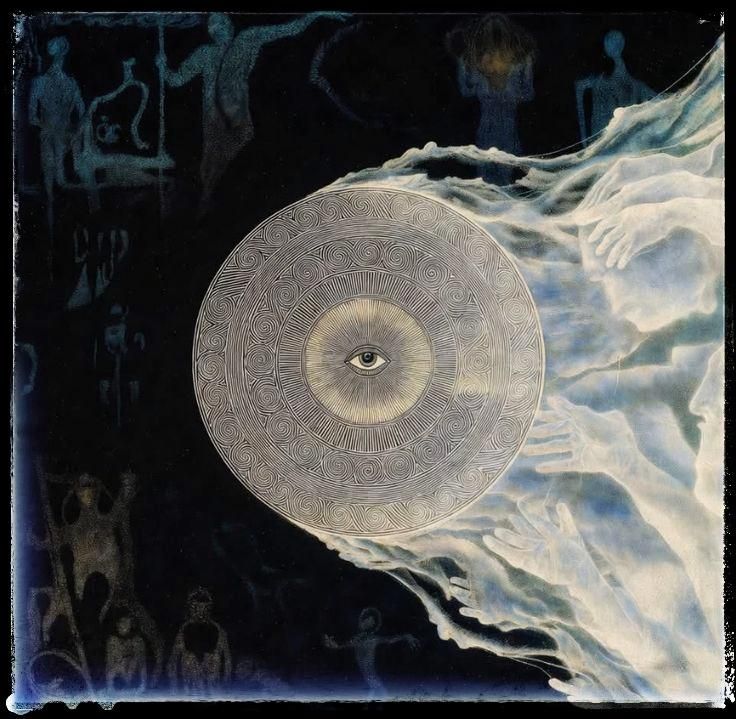
“I think, therefore I am.”
— René Descartes
I feel conflicted about this because experience exists outside of thinking, but the “I” does not exist outside of thinking. The self does, however, and it doesn’t need thoughts or a thinker to say it does exist. If you attach your being (or “am-ness”) to thoughts, then your being is fleeting and isn’t really here.
I would take it a step further and say if you attach your being to a thinker or a seer, you still aren’t really here outside of a relativistic or conventional lens that makes the statement true by the conditions of something to be seen/thought now creating the action of seeing/thinking.
I argue you are not these thoughts because you see them; you are not the seer because the seer is inseparable from the seen. You are neither seer nor seen, nor neither, nor both.
You aren’t the seer as you remain when there is nothing to see. You aren’t both because what is seen comes and goes just as the capacity for seeing. You might say, “You can see when there is nothing to see?” But nothing is not seen, so what is seeing nothing, I would inquire?
You play the role of the seer when the seen is here; yes, this is true. However the character is not the actor. The actor is only an actor by quality of playing a character; the role of actor is a character in and of itself. Therefore, you cannot separate the role of actor from the character. There is no reason to be an actor if the character is not there to act from. There would be no actor if there was no character. Therefore, they must be interdependent to be considered true. This is just as much the case for thinking and thought, feeling and feelings, seeing and seen. The two distinctions are merely one inseparable act expressed in a twofold nature of the raw experience itself.
You aren’t neither because the seen and seer are real in the experience of seeing and having seen. They just aren’t “yours”—they are your seeing, your feeling, your thoughts, your insights. But they aren’t you, just as the actor’s being isn’t the character’s being and the character’s being isn’t the actor’s. However, their nature of being exists relationally to each other, or else both cease.
So it begs the question: What are you then?
My take is it’s a bit of a trick question. The benefit of the inquiry, I believe, is not arriving at an answer, but rather observing the reaction to the absence of one. The silence between the answers that arise is the practice for recognizing the truth of our being.
In doing so, we can experience the reality of self directly, without explanations, without analysis, without description. That, in my experience, is the most simple way to arrive at the impression of your being and the nature of objective truth. It’s so profoundly simple. It’s effortless, stupidly simple. It feels too easy, or boring, or pointless.
It’s like your nose: you always see it, you’re always looking at it, but you don’t notice it unless you consciously recognize it. It gets filtered out as visual noise. Objective Reality gets filtered out in the noise of Subjective Reality much the same way the nose gets filtered out.
The subjective internal experience inherently separates the sense of being purely from the point of a single perspective. But as we all know, one perspective does not constitute reality. The separation from our being the world is artificially induced due to our own presuppositions about the nature of the self drawn from a limited perspective.
Every thought reflects a different thought or feeling. Every word requires several others to describe its purpose and definition. Every thing requires another to recognize it, to beget it, to sustain it, to see it. All phenomena are interdependent upon other phenomena; no phenomenon is self-sufficient.
“Self-made” is a myth or a platitude of one’s own effort. But even in that sense, effort itself requires an external reaction to validate its impact. Meaning itself requires a relationship of significance or value between two or more things.
Think about it: how is any given thing meaningful if it only has itself? How is a word with no description or relationship to nouns, verbs, or adjectives, etc., a meaningful word? It has no connection to something significant. Its descriptive capabilities are pointless unless we assign or discover its relationship to something else or a distinction from something else.
That is why the truth of self by itself is seemingly meaningless; if it wasn’t, there would be no meaning at all. I know that sounds bizarre or like another trick, but it’s not. This is insight into the truth of being. Truth itself only exists in a relationship of validation, confirmation, or correctness; truth in objectivity bears no distinction other than itself as it is.
Which makes it appear meaningless. But it’s not meaningless in a sense that it lacks value, but it is in the sense that it lacks distinction—its self-evident nature.
Once you discover the self-evident nature of truth, the self follows and vice versa. Everything is then made meaningful purely in the right that it appears. Everything becomes reflective and interdependent on everything else. It’s this absence of distinction in objectivity that gives rise to all distinction in subjectivity.
So that even in our most intimate sense of the self, subjectivity, by the nature of its own being, is truly inseparable from the world.
So you need not think to be, you need not know to be, you need not see to be. The self is effortlessly happening, spontaneously arising as reality experiencing itself.

